 Memecoin
 is an ERC-20 token for entertainment
Memecoin is Memeland’s token for entertainment on Ethereum, using the ticker MEME and the ERC-20 standard. Its fixed supply is 69 billion tokens. Holding it gives no voting or revenue rights, while distribution claims and Stakeland rewards follow separate program rules.
In short: Staking MEME commits tokens to Stakeland’s contracts and makes that staked amount unavailable for ordinary wallet transfers.
MEME transfers use an Ethereum token balance
Holding MEME in an Ethereum wallet allows its owner to receive and transfer the token between compatible addresses. The token contract records balances, and wallet software provides an interface for reading them and authorizing transfers. A transfer moves a specified amount to a recipient; it does not enroll either address in an NFT campaign or a staking program.
The destination must support the same asset on the selected network. This matters when sending to an exchange deposit address, where the provider defines its supported deposits. An Ethereum address alone does not establish whether that service will credit a particular token.
Token permissions control how applications spend MEME
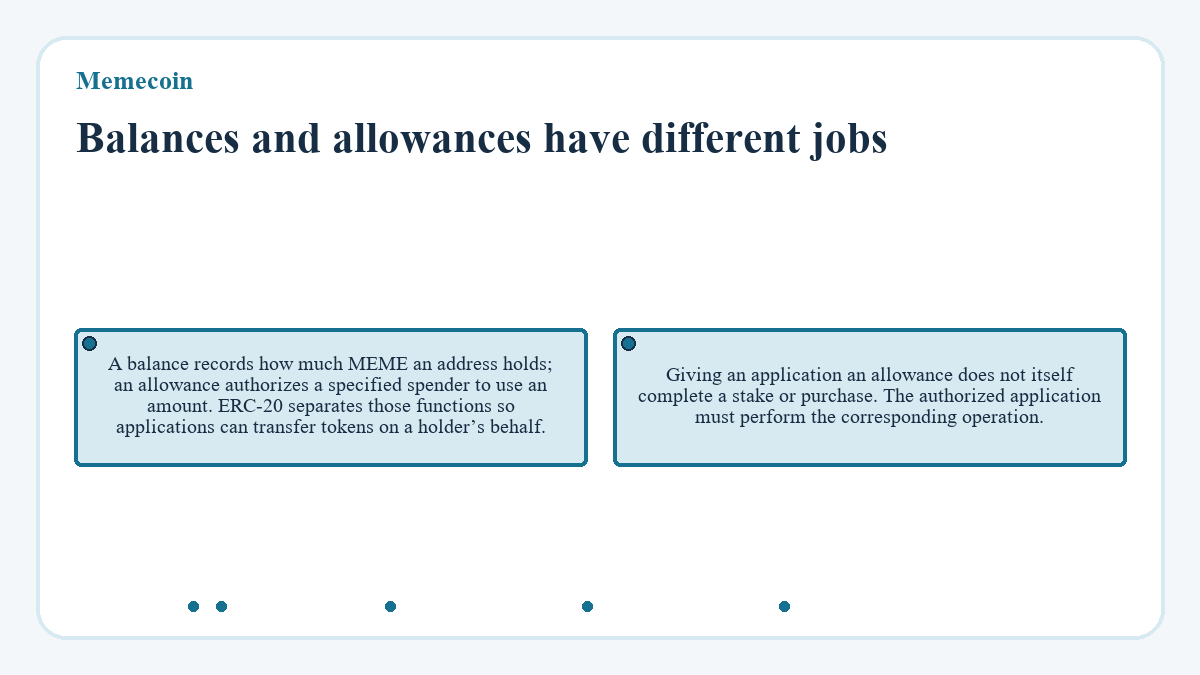
Balances and allowances have different jobs
A balance records how much MEME an address holds; an allowance authorizes a specified spender to use an amount. ERC-20 separates those functions so applications can transfer tokens on a holder’s behalf. Giving an application an allowance does not itself complete a stake or purchase. The authorized application must perform the corresponding operation.
Signed permits provide another authorization method
Stakeland’s staking gateway supports an ordinary MEME approval or an ERC-2612 permit. A permit uses a signed message to authorize spending, with a specified spender, amount, and deadline. Its signature therefore carries authority even before tokens move. MEME rejects a permit unless its spender matches the token contract’s configured tokenPool. The deadline limits when someone can submit the permit; it does not automatically expire the allowance the permit establishes.
What does the 69 billion supply figure mean?
The 69 billion figure describes MEME’s fixed total supply, rather than the amount circulating at a particular moment. Allocations have different unlocking schedules, and actual circulation also depends on claim activity. Tokenomics therefore involves both the overall quantity and the timing of its availability. An unlocked allocation can remain unclaimed, so the release schedule alone does not establish a live circulating balance.
Memeland combines tokens with NFT communities
The team behind 9GAG created Memeland as a venture studio focused on communities and social products. Its NFT collections include You The Real MVP, The Potatoz, and The Captainz. MEME adds a fungible token to that wider project: its units share the same token identity, while an NFT has its own individual identity.
Potatoz Growing, also called Grow-To-Win, describes a non-custodial mechanism where participating NFTs remain in their owners’ wallets. Growing lets them evolve while accumulating tickets for weekly prize draws. Owners must pull their Potatoz out before listing or transfer. Pulling out forfeits that Potatoz’s tickets and resets its evolution progress. Its promotional material mentions possible connections with MEME and airdrops as rumors, which does not establish a specific token allocation or an active claim entitlement.
Market purchases and original allocations follow different rules
Buying transferable MEME and collecting a distribution allocation involve different rights. A purchase acquires tokens from a seller; a claim draws on an existing allocation.
Trading the token
A market order involves the venue’s available liquidity and trading conditions. Exchange records can show a MEME balance before any withdrawal to a personal wallet. Trading access, custody, and withdrawals remain separate services. An old listing announcement does not establish which pairs, networks, or account permissions a venue supports today.
Collecting sale or airdrop allocations
The original distribution system distinguishes Fire Sale and private-sale allocations from NFT-linked airdrops. Each claim depends on the relevant entitlement, release, and expiry conditions. The original airdrop also covered eligible owners of wallets bound to Wallet Maps; Memeland reports that the NFT airdrop claim has ended. An allocation subject to lock-up restrictions does not become freely transferable simply because a market trades MEME. The original airdrop also imposes participant eligibility requirements. Buying tokens on a market does not create eligibility for that campaign.
A separate MultiClaim route with staking combines Fire Sale or airdrop claiming with staking in one operation. The combined route still depends on the allocation’s eligibility, release, and expiry conditions.
Gas charges pay for Ethereum execution
Ethereum gas fees pay for the computation a transfer or contract interaction consumes. The network charges gas fees in ETH, with the cost depending on execution and the applicable gas price. For an ordinary transaction sent directly from a self-custody wallet, holding MEME alone does not supply that ETH. A trading venue may separately charge for a trade or withdrawal. These charges have different bases, so a displayed trading fee does not describe the complete cost of moving tokens into a wallet.
Does MEME confer voting or revenue rights?
Holding MEME confers neither governance authority over Memeland nor a right to its business revenue. It also gives holders no entitlement to company profits or dividends. The Memecoin whitepaper dated 2 November 2023 describes an entertainment token without promised financial returns or a development roadmap. Separate staking campaigns can offer their own rewards without turning the underlying token into a company share.
Stakeland adds staking and project reward campaigns
Staking MEME earns Steaks
Stakeland accepts MEME into a staking contract and credits rewards called Steaks. Staking commits the tokens to that contract, removing them from the balance available for ordinary wallet transfers. Steaks measure participation within the reward system; their displayed quantity is distinct from the amount of MEME staked. The program’s campaign rules determine the applicable reward conditions.
Project tokens have their own release rules
Farming campaigns can distribute participating projects’ tokens, with separate claim contracts handling their release. Stakeland’s contract descriptions distinguish its MEME staking contract from FarmClaim contracts, including a separate deployment on Blast. A project’s reward asset, destination network, and unlocking schedule belong to that campaign. They do not change the network of the original Ethereum MEME token or create a common release schedule for every reward.
Unstaking changes the reward position
Stakeland’s general staking terms, updated 20 February 2024, allow unstaking at any time and specify that tokens return to the same wallet after network processing. Reward accrual on the unstaked tokens stops once the network processes and verifies the unstaking transaction. Those terms do not promise a fixed arrival time, reward amount, or reward value. Individual reward campaigns can impose additional conditions on their own tokens, so the general MEME staking rule does not define every project reward’s withdrawal terms.
Administrative controls affect distribution contracts
SlowMist’s September 2023 audit examined MEME’s sale and claim contracts, including privileged administrator functions. It recorded an acknowledged risk involving owner control over contract-held assets. In the reviewed claim contract, the owner could withdraw stored claim tokens only while claiming was closed. In the reviewed Fire Sale contract, the owner could withdraw sale proceeds only after the sale finished.
These permissions concern assets inside the specified contracts. They do not describe a power to collect arbitrary MEME balances from every holder’s wallet.
The project’s published administration model requires approval from two of three multisignature owners. This reduces dependence on a single signing key while retaining administrator authority. The historical audit covers its reviewed code and scope; it does not certify later contracts or establish the security of an unrelated application requesting a MEME allowance.
Why can MEME trade at changing prices?
MEME’s market price changes as buyers and sellers trade at different prices, even though its total supply stays fixed. Available liquidity affects the price an order can obtain, while release and claim activity affect how many tokens can circulate. Neither the supply cap nor Memeland’s other products specifies a redemption value. The entertainment purpose also carries no promise of earnings. A token balance measures units held; its market value requires a price for those units at the relevant time.
Choose between a transfer, an allocation claim, and staking
A transfer moves an existing MEME balance, a claim collects a distribution entitlement, and staking commits tokens to Stakeland’s rewards system. An NFT or a reward balance belongs to the same wider ecosystem without representing the same holding.
- For a MEME transfer, use the Ethereum token balance and a destination supporting that token and network.
- For original allocations, check eligibility, release, and expiry for the sale, NFT, or Wallet Maps entitlement; Memeland marks the NFT airdrop claim as ended.
- For the described Potatoz Growing program, weekly prize tickets do not specify a MEME allocation.
- For project reward claims, keep the campaign’s token, network, and unlocking conditions together.
- For MEME staking, distinguish the committed token amount from Stakeland’s reward measure, Steaks.
Frequently asked questions about Memecoin
Which contract identifies the Ethereum MEME token?
The Ethereum MEME token contract is 0xb131f4A55907B10d1F0A50d8ab8FA09EC342cd74. This address identifies the token across compatible wallets and token records. Fire Sale, airdrop, and staking contracts perform different operations, so their addresses are not substitutes for the token contract.
Does a failed MEME transaction still cost gas?
A MEME transaction which executes on Ethereum and then reverts still consumes gas. The network charges for the computation it performed, even though the intended transfer or contract operation failed. A wallet rejecting an action before submission is a different state and does not itself establish an on-chain gas charge.
Can a new Potatoz owner claim MEME a previous holder already collected?
A new NFT owner cannot reclaim the portion of an original MEME airdrop allocation a previous holder already claimed. The original airdrop rules also make claims subject to eligibility, release, and expiry conditions. Memeland’s Potatoz profiles report that the MEME airdrop claim has ended; buying a Potatoz does not reopen it.
When do original MEME airdrop claims expire?
The original airdrop’s relevant claim period ends 69 days after full release of the corresponding allocation category. The Memeland Airdrop Terms and Conditions, version 1.2 dated 7 November 2023, distinguish Maps and Valuables allocations from NFT allocations. After each deadline, holders forfeit rights to released but unclaimed tokens. Memeland reports that the NFT airdrop claim has ended.
Are MEME transfers private?
Ethereum MEME transfers expose token amounts and participating wallet addresses through public transaction data and transfer events. An address does not itself contain its owner’s real name. Linking that address to an identifiable account can connect publicly visible activity with a person.
How many decimal places does MEME support?
MEME supports 18 decimal places. Wallet interfaces may display fewer digits for readability, while the token contract accounts for the underlying units. A rounded display does not change the actual token balance or convert a fraction into a whole MEME.
Last updated ·